
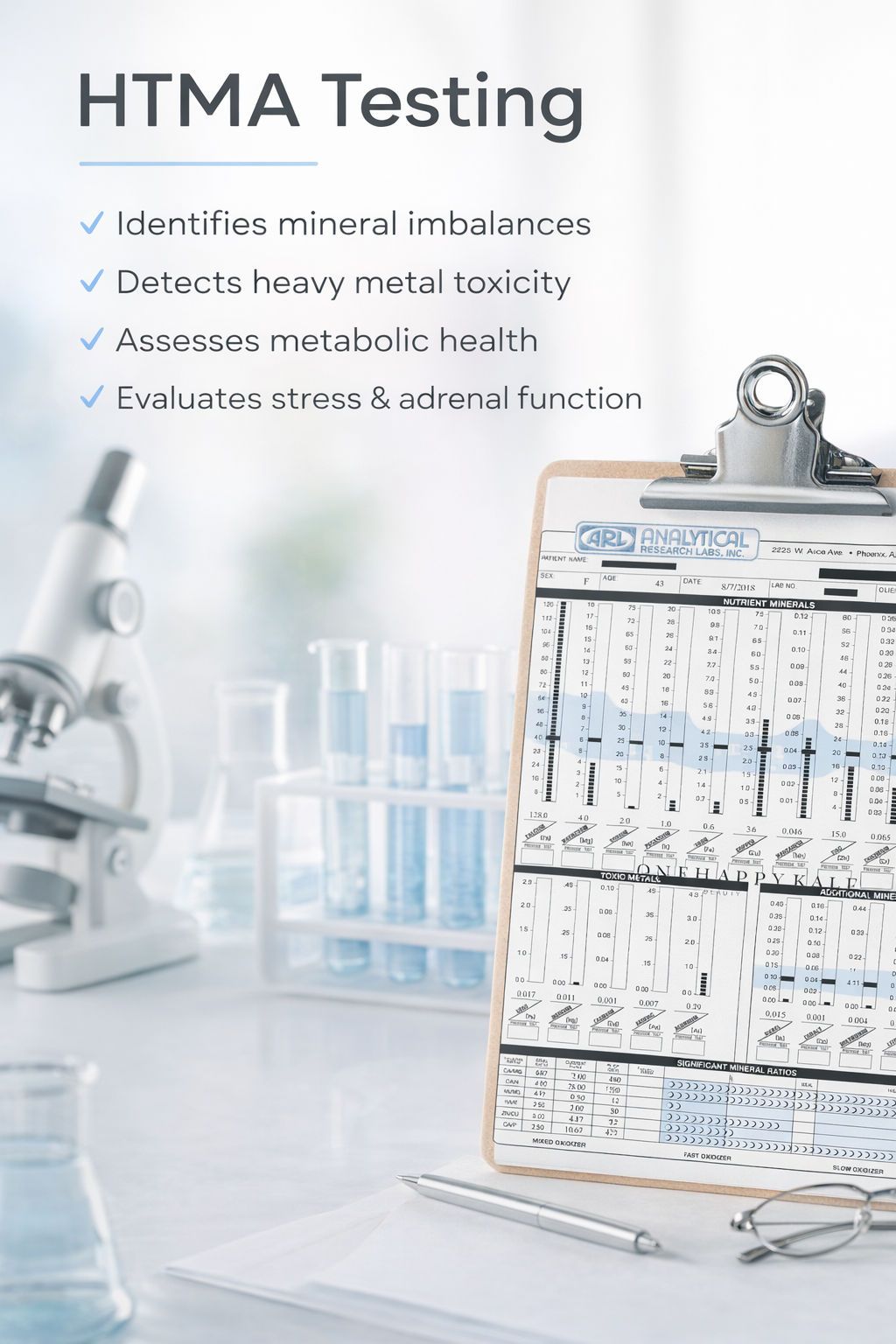
What Is HTMA Testing?
You got your labs back. Everything looks normal. But you’re exhausted, your skin is breaking out, your digestion is off, and something still doesn’t feel right. Sound familiar? If standard bloodwork keeps coming back “fine” while you feel anything but, there may be something worth looking at that most tests skip entirely. Hair Tissue Mineral Analysis (HTMA) is a functional screening tool that looks at what’s been happening inside your cells for months, not just what’s circulating in your blood right now.
What Does HTMA Stand For?
HTMA stands for Hair Tissue Mineral Analysis. You’ll also hear it called hair mineral analysis or hair mineral testing. All three terms refer to the same thing: a lab test that analyzes a small sample of your hair to measure mineral and heavy metal levels stored in your tissues.
Unlike blood panels, which measure what’s floating around in your bloodstream at a single point in time, HTMA captures a longer metabolic record. Your hair holds onto minerals as it grows, giving labs a window into roughly the past three months of your body’s mineral activity.
What Does HTMA Test For?
HTMA measures three main categories: essential minerals your body needs, toxic heavy metals you’re better off without, and the ratios between those minerals, which often tell the most interesting story of all.
Essential Minerals
The test looks at the minerals your body depends on every day for energy, immune function, hormonal balance, and cellular repair. These typically include:
- Calcium
- Magnesium
- Potassium
- Sodium
- Zinc
- Copper
- Iron
- Manganese
- Chromium
- Selenium
- Phosphorus
High or low levels of any of these can point to patterns worth exploring, but context matters. No single mineral level tells the whole story.
Toxic Heavy Metals
HTMA also screens for heavy metals that accumulate in your tissues over time, including:
- Lead
- Mercury
- Arsenic
- Aluminum
- Cadmium
- Uranium
Exposure can come from food, water, dental work, environmental sources, and everyday products. Most people are surprised to see anything show up. Some are surprised by how much.
Mineral Ratios
This is where HTMA gets genuinely interesting, and where a trained practitioner adds the most value. Individual mineral levels matter, but the relationships between minerals matter just as much. The calcium-to-phosphorus ratio (Ca:P) can reflect metabolic rate. The sodium-to-potassium ratio (Na:K) is often called the “vitality ratio” because it may indicate adrenal output and cellular energy. The zinc-to-copper ratio (Zn:Cu) is closely tied to immune function, inflammation, and hormonal patterns. The calcium-to-magnesium ratio (Ca:Mg) can reveal information about cardiovascular and nervous system function. These ratios show how minerals are working together, or competing, inside your tissues. That’s something a single-mineral blood test can’t capture.
What Can HTMA Reveal About Your Health?
HTMA is a screening tool, not a diagnosis. But it can surface patterns that are worth paying attention to, especially when you’ve been symptomatic without clear answers.
Zinc and copper have a close relationship, and an imbalance between them may be connected to skin concerns like hormonal acne. Copper excess relative to zinc is a pattern that comes up frequently in women dealing with persistent breakouts.
The calcium-to-potassium ratio may help reveal patterns related to thyroid and adrenal function. When adrenal output is under stress for a long period, you often see it reflected in mineral patterns before it shows up clearly in other testing.
Magnesium and sodium are both tied to gut function and stress response. Low magnesium in particular is associated with constipation, muscle tension, and poor sleep. You can read more about how mineral imbalances affect digestion and what that can look like day to day.
Oxidation rate, which refers to how fast or slow your metabolism is running at the cellular level, is something HTMA can help identify. Fatigue and low energy often have a mineral story behind them, even when thyroid labs look normal.
Why HTMA Reveals What Blood Tests Miss
Your body is remarkably good at keeping your blood chemistry stable. That’s a survival mechanism. When minerals drop in your tissues or cells, your body will pull from storage to keep blood levels in range. Bones, organs, muscles, and soft tissue all serve as reserves.
The result? Your blood test looks normal. Your body is depleted. You feel terrible and have no idea why.
Blood tests are a snapshot of one moment. HTMA is more like a three-month log. It reflects what’s been stored and used at the cellular level over time, which is exactly the window that standard labs tend to miss. That’s why the two types of testing aren’t in competition. They’re looking at different things.
How Does the HTMA Test Work?
The process is straightforward. You cut a small sample of hair, roughly 1 to 1.5 inches, from the nape of your neck, close to the scalp. That section captures the most recent growth and gives the lab the most accurate read. You package it up and mail it to the lab. No needles, no fasting, no clinic visit.
Results are typically returned within a couple of weeks. What you get back is a detailed chart showing your mineral and metal levels compared to reference ranges, along with ratio calculations. The chart is informative, but it doesn’t interpret itself. That’s where working with someone trained in HTMA analysis makes a real difference.
Is HTMA Testing Accurate?
This is a fair question, and it deserves an honest answer. HTMA is a legitimate screening tool with decades of use in functional and integrative health, but it has limitations worth knowing about.
External products like certain shampoos, conditioners, or hair treatments can affect mineral readings if they contain minerals or metals. For this reason, labs typically ask you to submit untreated hair and to avoid specialty hair products in the days before sampling.
HTMA is not a standalone diagnostic. It doesn’t replace bloodwork, and it doesn’t tell you with certainty what’s wrong. What it does is reveal patterns that can guide a more targeted health conversation.
Lab methodology matters too. Standardized methods like those used by Analytical Research Labs (ARL) are considered more reliable for functional interpretation than less controlled testing environments. Interpretation by a trained practitioner, not just a report printout, is what gives HTMA its real value.
Who Is HTMA Testing Right For?
HTMA is a good fit for anyone who wants a deeper look at their mineral status, particularly if standard lab work has left them without answers. It comes up most often for women dealing with:
- Unexplained fatigue that doesn’t resolve with sleep
- Hormonal imbalances or cycle irregularities
- Persistent skin issues, especially hormonal acne
- Chronic digestive complaints like bloating, constipation, or sluggish motility
- Ongoing stress with physical symptoms (hair loss, low libido, poor recovery)
- Curiosity about heavy metal exposure or overall mineral status
At One Happy Kale, the HTMA Deep Dive starts at $497 and includes personalized interpretation of your results, not just a report. If you’re also interested in broader wellness support, 1:1 wellness coaching can work alongside your HTMA results to build a plan tailored to what the data actually shows.
What Happens After Your HTMA?
When your results come back, you’ll receive a chart showing each mineral and metal level plotted against reference ranges, plus your key ratio calculations. On its own, that chart raises as many questions as it answers. The interpretation is what makes it useful.
Michelle’s HTMA Deep Dive includes a 90-minute consultation to walk through your results together. That’s enough time to look at your mineral patterns in the context of your symptoms, your history, and your goals, and to come away with a concrete sense of what to do next.
If you want to know what’s included and how the process works, you can learn more about our HTMA testing packages before you decide.
Start feeling good again. Your minerals have a story. Let’s find out what it says.


